
Full-Mouth Rehabilitation Case Study • Newport Beach
Full-Mouth Rehabilitation • E.max Veneers • E.max Crowns • Zirconia Bridges • Final Shade A1
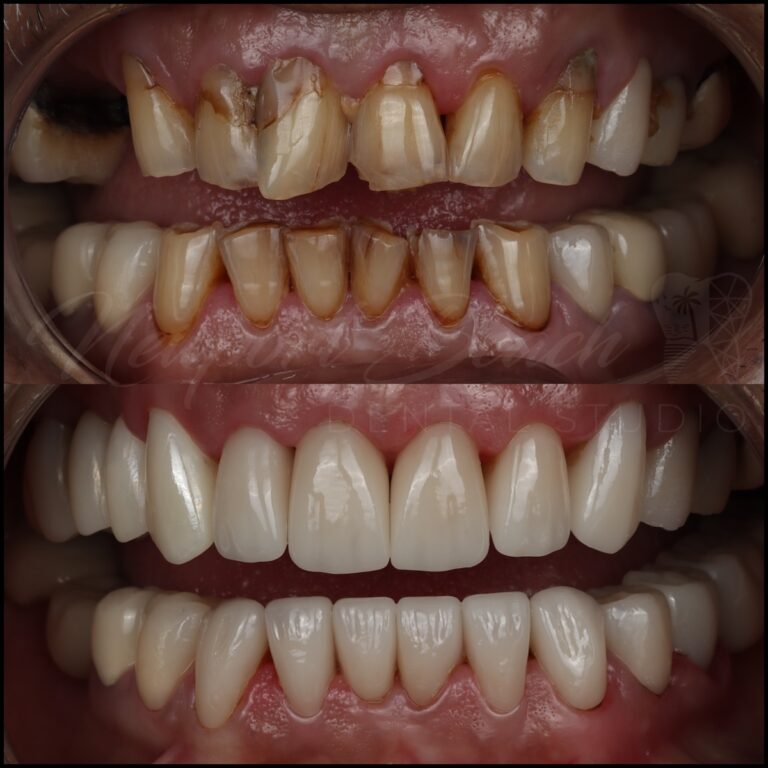
The Patient’s Starting Point
This patient presented to Newport Beach Dental Studio with extensive restorative needs affecting both the upper and lower arches. He had generalized decay involving multiple teeth, along with missing teeth in the upper right and lower left areas of his mouth.
The existing dentition showed widespread structural and esthetic compromise. Because multiple teeth and several areas of the mouth were affected at the same time, treating individual teeth in isolation would not have adequately addressed the overall condition.
A comprehensive full-mouth rehabilitation was planned to restore damaged teeth, replace missing teeth and rebuild the upper and lower arches in a coordinated way.
What We Changed
BEFORE
- Generalized decay throughout the dentition
- Multiple structurally compromised teeth
- Missing teeth in the upper right quadrant
- Missing teeth in the lower left quadrant
- Uneven color and tooth form
- Loss of continuity across the upper and lower arches
AFTER
- Upper and lower arches comprehensively restored
- Damaged teeth restored with E.max veneers and crowns
- Missing teeth replaced with zirconia bridges
- Improved tooth form and proportions
- More uniform overall shade
- Final shade A1
Why a Full-Mouth Rehabilitation Was Needed
When decay, missing teeth and structurally compromised teeth are present throughout multiple areas of the mouth, treatment becomes more complex than simply repairing one tooth at a time.
In this case, the upper and lower arches needed to be evaluated and restored as part of one comprehensive plan. The objective was to rebuild the dentition in a coordinated sequence so that the final restorations would work together visually and functionally rather than appearing as unrelated individual repairs.
Three Restorative Solutions, One Comprehensive Plan
This rehabilitation required a combination of E.max veneers, E.max crowns and zirconia bridges. Each restoration type served a different purpose within the overall treatment plan.
E.max veneers were used where conservative anterior esthetic coverage was appropriate. E.max crowns were used where teeth required more comprehensive coverage because of the amount of remaining tooth structure and restorative need. Zirconia bridges were used to replace missing teeth and restore continuity in the edentulous areas.
Using different restorative designs allowed the treatment to be tailored to the condition and function of each individual tooth and region rather than forcing every tooth into the same type of restoration.
E.max Veneers & Crowns
E.max ceramic was incorporated into the case in both veneer and full-coverage crown forms. The specific restoration selected depended on how much tooth structure remained and how much structural support each tooth required.
Where sufficient tooth structure could be preserved and the primary objective was esthetic improvement, veneers provided a more conservative ceramic option. Teeth with more extensive decay or structural compromise required greater coverage and were restored with E.max crowns.
Replacing the Missing Teeth With Zirconia Bridges
The patient was also missing teeth in the upper right and lower left areas of his mouth. These spaces needed to be incorporated into the rehabilitation rather than left untreated.
Zirconia bridges were used to replace the missing teeth and help restore continuity through these regions. This allowed the missing spaces to become part of the same comprehensive restorative design as the adjacent natural teeth.
Restoring Color, Form & Continuity
The final restorations were completed in shade A1, providing a brighter appearance while maintaining a natural tooth-colored result.
Shade alone, however, was only one part of the rehabilitation. The treatment also improved tooth form, proportions and continuity across both arches.
The objective was for the veneers, crowns and bridges to visually function as components of the same complete rehabilitation rather than three obviously different types of restorations.
Completed in Five Treatment Appointments
01 — Consultation & Treatment Planning
The initial appointment focused on evaluating the patient’s generalized decay, missing teeth, remaining tooth structure and overall restorative needs. The upper and lower arches were planned as components of one comprehensive rehabilitation.
02 — Upper Arch Preparation
The upper arch was prepared first. The individual teeth were prepared according to whether they were receiving an E.max veneer, E.max crown or serving as part of the planned zirconia bridge restorations.
03 — Upper Arch Delivery
The definitive upper restorations were delivered and evaluated for fit, contour, esthetics, shade and overall integration across the arch.
04 — Lower Arch Preparation
After completion of the upper arch, the lower arch was prepared according to the restorative plan.
05 — Lower Arch Delivery
The definitive lower restorations were delivered, completing the active restorative phase of the full-mouth rehabilitation.
Sixth Appointment — Post-Operative Follow-Up
Approximately one week after completion of the lower arch, the patient returned for a post-operative evaluation.
The restorations, bite and overall comfort were evaluated and the patient was asked about any issues following treatment. No complications were noted, and he was extremely satisfied with the final result.
Treatment Details
| Treatment | Full-mouth rehabilitation |
| Primary Conditions | Generalized decay, structurally compromised teeth and missing teeth |
| Restorations | Combination of E.max veneers, E.max crowns and zirconia bridges |
| E.max Veneers | Used where more conservative ceramic coverage was appropriate |
| E.max Crowns | Used on teeth requiring greater restorative coverage |
| Zirconia Bridges | Used to replace missing teeth and restore continuity through edentulous areas |
| Missing Teeth | Upper right quadrant and lower left quadrant |
| Final Shade | A1 |
| Active Treatment Appointments | 5 |
| Follow-Up | 1 additional post-operative appointment approximately one week later |
| Total Visits | 6 including consultation and follow-up |
| Outcome | No complications reported; patient extremely satisfied |
The Final Result
This case represents a comprehensive reconstruction rather than an isolated cosmetic procedure. The patient’s generalized decay, structurally compromised teeth and missing posterior teeth required treatment across both arches.
By combining E.max veneers, E.max crowns and zirconia bridges, different areas of the dentition could be restored according to their individual structural and esthetic requirements while remaining part of one coordinated rehabilitation.
The completed treatment produced a significantly more complete, uniform and harmonious dentition in a final A1 shade. Following final delivery and the subsequent post-operative evaluation, no complications were reported and the patient was extremely satisfied with the outcome.
Does Your Smile Need More Than a Single-Tooth Fix?
When decay, missing teeth and compromised restorations affect multiple areas of the mouth, comprehensive treatment planning can help determine how to restore the dentition as a whole rather than one tooth at a time.