
Curodont Early Cavity Treatment in Newport Beach
Not every cavity needs to begin with a dental drill. When tooth decay is discovered early enough—before the enamel surface has broken down—we may have an opportunity to treat the lesion non-invasively and preserve the tooth structure that is still there.
At Newport Beach Dental Studio, Dr. Tai Ha offers Curodont Repair Fluoride Plus for selected early, non-cavitated caries lesions and white-spot lesions.
Curodont uses self-assembling peptide technology together with fluoride to support remineralization within an early enamel lesion. The treatment is applied directly to the affected area in the dental office and does not require drilling, numbing, or placement of a conventional filling when the lesion is an appropriate candidate.
The important part is timing. Once a tooth has developed structural cavitation or decay has progressed to the point that damaged tooth structure must be removed, Curodont is no longer a substitute for restorative treatment.
Curodont provides a non-invasive treatment option for selected early enamel cavities at Newport Beach Dental Studio.
What Is Curodont Repair Fluoride Plus?
Curodont Repair Fluoride Plus is a professional in-office treatment intended for initial caries lesions and white spots.
Its key technology is a self-assembling peptide known as P11-4. After being applied to an appropriate early lesion, the peptide diffuses into the porous demineralized area and self-assembles into a microscopic matrix.
That matrix provides a scaffold within the lesion where naturally available calcium and phosphate minerals can accumulate. The product also incorporates fluoride as part of the remineralization process.
Rather than cutting away the affected area and replacing it with restorative material, the objective is to help the tooth regain mineral within the early lesion while the enamel surface is still intact.
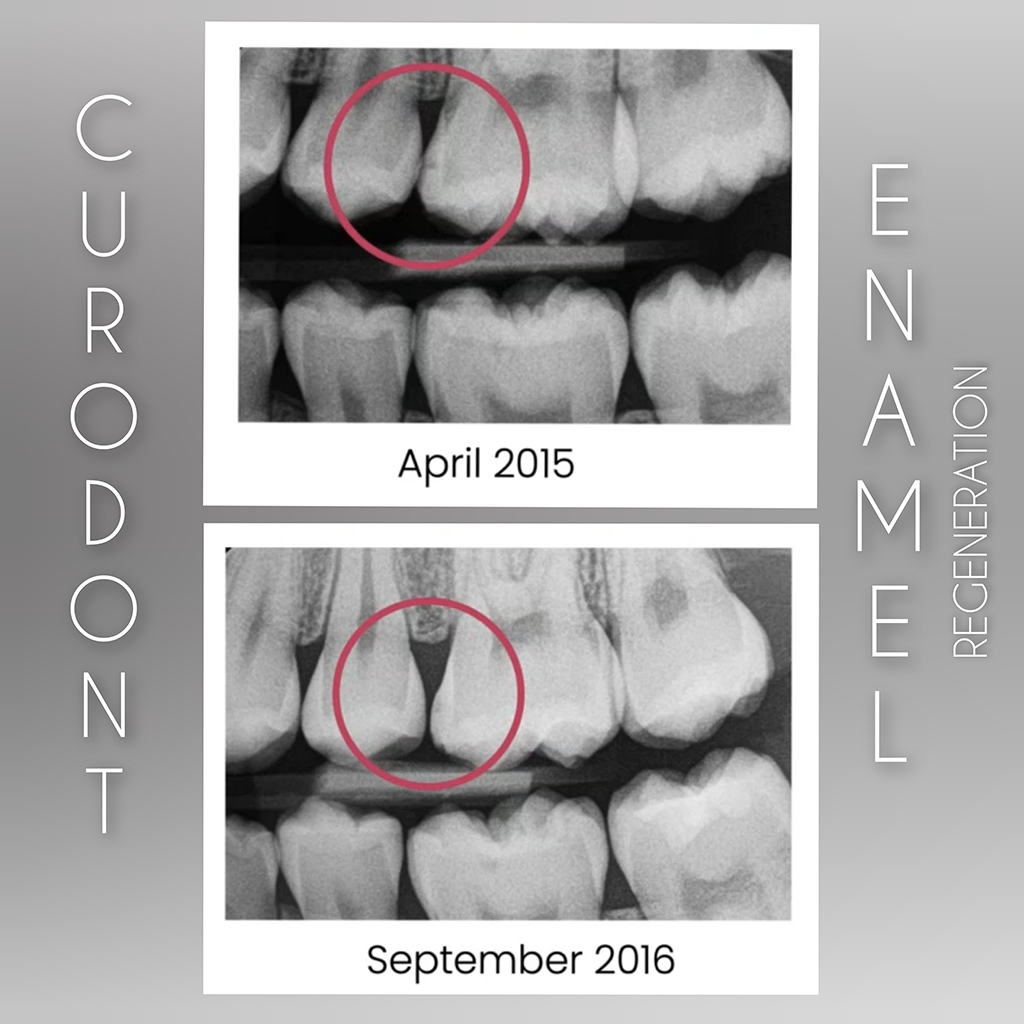
How Does Curodont Help an Early Cavity?
An early cavity does not begin as a hole. Before enamel physically collapses, acids produced within dental plaque can remove minerals from underneath the tooth surface. This creates a porous area of demineralized enamel.
Clinically, these early lesions may appear as a white spot, or they may first be identified on a dental X-ray before any visible hole exists.
Curodont is intended to intervene during this earlier stage.
Can Curodont Actually Regenerate Enamel?
You will often see the process described as Guided Enamel Regeneration. The terminology refers to supporting new mineral formation within an early, demineralized enamel lesion.
It is important to understand what that does—and does not—mean.
Curodont does not grow back a missing chunk of tooth or rebuild a cavity after the enamel surface has physically collapsed. Its role is in the treatment of initial, non-cavitated lesions, where the tooth surface remains sufficiently intact for remineralization to be a reasonable treatment strategy.
Clinical studies of self-assembling P11-4 peptides have shown increased caries arrest and regression of early lesions compared with control treatments in several study populations. As with any preventive treatment, however, response varies and the tooth still needs to be monitored over time.
Which Cavities Can Be Treated With Curodont?
The word “cavity” is commonly used for every stage of tooth decay, but clinically there is an important difference between an early caries lesion and a tooth that already has a physical hole.
Curodont May Be Considered When:
The lesion is early and non-cavitated, the tooth surface remains intact, and the clinical examination and X-rays suggest that non-invasive caries management is appropriate.
A Filling May Be Needed When:
The tooth has developed structural cavitation, decay is too extensive for remineralization alone, the surface has broken down, or the tooth requires removal of diseased or unsupported structure.
Where Can Early Cavities Occur?
What to Expect During Curodont Treatment
The actual application is relatively simple, but proper diagnosis and preparation of the lesion are important.
Curodont Treats the Lesion—But We Still Have to Treat the Cause
Dental decay is a disease process, not simply a collection of holes that appear in teeth.
If a patient continues to experience frequent acid exposure, inadequate plaque removal, low fluoride exposure, dry mouth, high sugar frequency, or other significant caries risk factors, simply treating one early lesion does not prevent another one from developing.
That is why Curodont is most useful as part of a broader preventive plan. Depending on your risk, we may also discuss prescription-strength fluoride, professional fluoride, changes in home care, diet, saliva management, more frequent preventive visits, or other strategies.
Curodont vs. a Traditional Filling
These treatments are not competitors for the same type of lesion. They are used at different stages of the disease process.
Early Non-Cavitated Lesion
When the enamel surface remains intact and the lesion is suitable for non-invasive management, Curodont may give us an opportunity to preserve the tooth without cutting a preparation.
Cavitated or More Advanced Lesion
When tooth structure has broken down or decay requires mechanical removal, the tooth generally needs restorative treatment such as a bonded filling or another appropriate restoration.
Why Curodont Fits Our Conservative Dental Philosophy
At Newport Beach Dental Studio, Dr. Ha practices with a strong emphasis on preserving healthy tooth structure.
Once enamel and dentin are removed for a restoration, that natural structure cannot simply be put back. A filling may eventually need to be replaced, and every replacement can potentially make the restoration larger.
When we can appropriately arrest an early lesion before drilling becomes necessary, we have an opportunity to interrupt that restorative cycle before it starts.
That does not mean avoiding fillings when a tooth genuinely needs one. It means distinguishing between a lesion that can reasonably be treated non-invasively and one that has progressed far enough to require restoration.
Can Curodont Treat White Spots on Teeth?
Some white spots represent areas where enamel has lost mineral and become more porous. These can occur because of early caries, particularly around orthodontic brackets or in areas where plaque has accumulated.
Curodont is used professionally for selected white-spot and initial caries lesions. Whether it is the appropriate treatment depends on why the white spot developed and whether the lesion is active.
Not every white mark on a tooth is decay. Fluorosis, developmental enamel defects, hypomineralization, trauma, and other conditions can create a similar appearance and may require a different cosmetic or restorative approach.
What Does the Research Say About Curodont?
Self-assembling peptide P11-4 has been studied in multiple clinical trials for the treatment of initial carious lesions.
A systematic review published in the Journal of the American Dental Association found that Curodont Repair likely increased caries arrest and reduced lesion size compared with control groups. The authors also noted limitations in the available evidence and recommended additional longer-term research.
More recent randomized clinical research evaluating Curodont Repair Fluoride Plus has also reported greater remineralization measurements than fluoride varnish alone during follow-up of non-cavitated early lesions.
For us, the takeaway is straightforward: Curodont is a useful additional option for appropriately selected early lesions, but it does not replace diagnosis, prevention, monitoring, or restorative dentistry when those are needed.
Frequently Asked Questions About Curodont
Can Curodont reverse a cavity?
Curodont is intended for initial, non-cavitated caries lesions where remineralization is still a reasonable treatment strategy. It cannot rebuild a physical hole or replace missing tooth structure after cavitation has occurred.
Can a cavity really be treated without drilling?
Some early lesions can be managed non-invasively before drilling becomes necessary. Whether this is appropriate depends on the lesion’s depth, activity, surface integrity, location, and the patient’s overall risk for decay.
Does Curodont hurt?
Curodont application itself is non-invasive and generally does not require drilling or a local anesthetic injection. The tooth is professionally cleaned and conditioned before the material is applied.
How long does Curodont take?
The chairside application is relatively brief. Mineral changes within the lesion occur over time, so treatment success is evaluated during subsequent dental visits rather than immediately after application.
Does Curodont work immediately?
The material is applied during a single office visit, but remineralization is a biological process that continues afterward. The goal is lesion arrest and mineral recovery over time, not an immediate cosmetic transformation.
Can Curodont treat decay between teeth?
Selected non-cavitated interproximal lesions may be candidates. These lesions are often identified on bitewing X-rays. Dr. Ha must evaluate the depth and clinical condition before recommending treatment.
Can Curodont treat a cavity that has reached dentin?
Candidacy should not be determined from one X-ray measurement alone. Once a lesion has structurally cavitated or progressed to the point that diseased tooth structure must be removed, Curodont is not a substitute for a filling. Dr. Ha will determine whether non-invasive management remains appropriate.
Can Curodont treat white spots after braces?
Some post-orthodontic white spots are early demineralization lesions and may be candidates for remineralization treatment. Other white spots have different causes, so the tooth should first be examined to determine what produced the discoloration.
Will I still need fluoride after Curodont?
Usually, caries prevention remains important. Fluoride toothpaste, good plaque control, diet, saliva, and other preventive measures help create an environment in which the treated lesion can remain stable.
How do you know if Curodont worked?
The lesion is monitored over time through clinical examination and, when appropriate, follow-up dental imaging. The goal is for the lesion to remain arrested or show evidence of regression rather than continue progressing toward cavitation.
Learn more about Curodont Repair Fluoride Plus
Have You Been Told You Have an Early Cavity?
If you have a small area of decay and want to know whether it can be treated before a filling becomes necessary, schedule an evaluation with Dr. Ha at Newport Beach Dental Studio.
We can examine the tooth, review your X-rays, determine whether the lesion is still appropriate for non-invasive treatment, and explain the difference between monitoring, remineralization with Curodont, and restorative treatment when a filling is actually needed.
SCHEDULE AN APPOINTMENTCurodont is intended for selected initial caries lesions and is not a substitute for restorative treatment when a tooth has cavitated or requires removal of diseased tooth structure. Treatment response varies and follow-up is required.