
Cosmetic Dentistry Case Study • Newport Beach
10 Injectable Composite Veneers • Teeth #4–13 • No Tooth Reduction • Final Shade B1
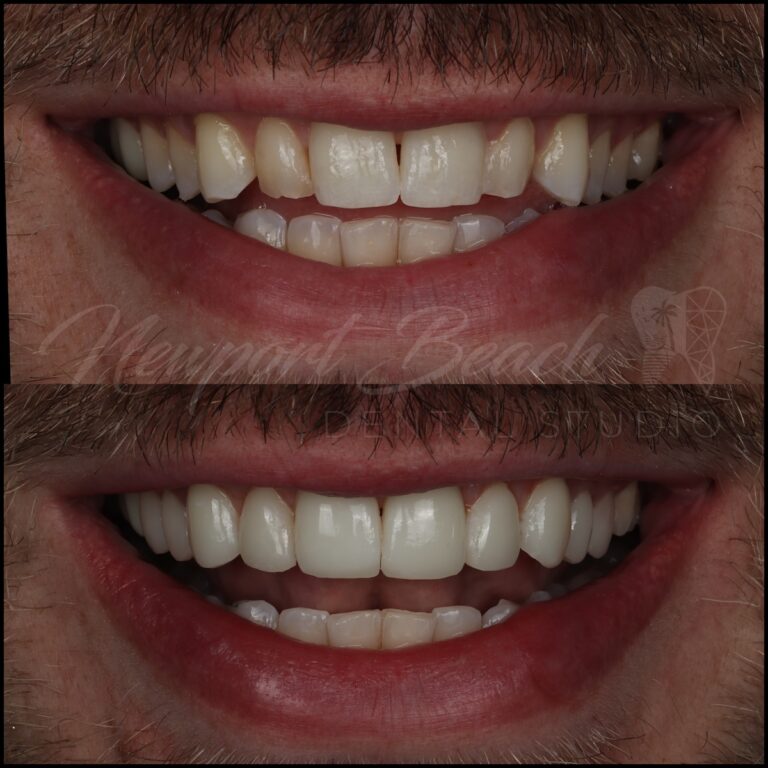
The Patient’s Concern
This patient came to Newport Beach Dental Studio interested in improving his smile but had one very specific requirement: he did not want his natural teeth shaved down. His anterior teeth were retroclined, meaning they were positioned slightly inward, and they also demonstrated existing wear and loss of tooth length. Rather than being a limitation, this anatomy provided an opportunity to consider a completely additive approach. Ten injectable composite veneers were planned from teeth #4 through #13 to increase tooth volume, restore worn areas and improve the overall proportions of the smile without intentionally removing enamel.What We Changed
BEFORE
- Retroclined anterior teeth
- Existing wear and reduced tooth length
- Less prominent anterior tooth position
- Uneven tooth proportions
- Patient wanted to avoid tooth reduction
AFTER
- 10 teeth restored from #4 through #13
- Improved anterior tooth volume
- Restored worn tooth length
- More balanced smile proportions
- Final shade B1
- No intentional enamel removal
Why a No-Prep Approach Worked for This Smile
No-prep treatment is not appropriate for every cosmetic case. In this patient’s situation, however, the starting position and shape of the teeth worked in our favor. Because the anterior teeth were already retroclined and worn, there was room to add restorative material outward and restore lost tooth volume without first needing to remove healthy enamel to create space. This allowed the case to remain completely additive. Instead of reducing the teeth and replacing enamel with restorative material, composite was added to the existing tooth structure to create the planned contours.How Injectable Composite Veneers Work
Injectable composite veneers begin with the design of the final tooth shapes before the definitive restorations are placed.
For this case, a diagnostic wax-up was created to establish the planned tooth length, width, contour and overall smile proportions. A stent was then fabricated from that design.
During treatment, flowable composite was injected through the stent onto the tooth surfaces. The stent transferred the predetermined design into the mouth, after which each restoration was refined, shaped and polished.
Designed Before the Composite Was Injected
The restorative result was not created freehand from the beginning. The wax-up served as the blueprint for the intended tooth shapes before the treatment appointment. That design was transferred into a custom stent, which allowed the flowable composite to reproduce the planned contours directly on the patient’s teeth. Once the material was placed, the restorations were individually refined and polished to create the final surface finish and transitions.Completed in Three Appointments
01 — Consultation & Planning
The patient’s existing tooth position, wear, proportions and cosmetic goals were evaluated. Because preserving his natural tooth structure was a priority, an additive injectable composite approach was planned.
02 — Injectable Composite Veneers
After the wax-up was completed and the custom stent was fabricated, the patient returned for the restorative appointment. Flowable composite was injected and transferred onto teeth #4 through #13 using the stent. Each restoration was then refined, shaped and polished, and the patient’s occlusion was carefully evaluated.
The complete restorative appointment took four hours.
03 — Post-Operative Check
The patient returned for a postoperative evaluation. The restorations and occlusion were reassessed, and any minor adjustments were completed as needed.
Treatment Details
| Treatment | Injectable composite veneers |
| Number of Teeth | 10 |
| Teeth Treated | #4 through #13 |
| Restorative Material | Flowable composite |
| Design | Diagnostic wax-up transferred with a custom injection stent |
| Tooth Preparation | No intentional enamel removal |
| Starting Condition | Retroclined and worn anterior teeth |
| Final Shade | B1 |
| Restorative Appointment | 4 hours |
| Total Appointments | 3 — consultation, restorative treatment and postoperative evaluation |
| Fee for This Case | $650 per tooth |
| Total Treatment Fee | $6,500 for 10 teeth |
| Expected Lifespan | Approximately 5–10 years with appropriate care and maintenance |
| Future Treatment | Can serve as a conservative transitional option before porcelain veneers if desired in the future |
What Did This Treatment Cost?
For this particular case, the fee was $650 per tooth. Ten teeth were treated from #4 through #13, resulting in a total restorative fee of $6,500. The cost of injectable composite veneer treatment can vary depending on the number of teeth being treated, the complexity of the starting condition, the amount of restorative material required and the design of the individual case. A cosmetic consultation is necessary to determine whether an additive injectable technique is appropriate and to provide an individualized treatment plan.How Long Do Injectable Composite Veneers Last?
A reasonable expected lifespan for injectable composite veneers is generally about 5–10 years, although individual results can vary.
Longevity depends on factors such as bite forces, grinding or clenching, oral hygiene, dietary habits, staining, maintenance, and whether the composite experiences chipping or wear over time.
One advantage of composite is that it can often be polished, repaired or modified more conservatively than a ceramic restoration if small areas of wear or damage occur.
A Conservative Step Before Porcelain Veneers
For some patients, injectable composite veneers can also serve as a transitional stage before eventually considering porcelain veneers. This approach allows a patient to improve tooth length, contour, color and overall smile proportions while maintaining a highly conservative treatment philosophy. It can also give the patient an opportunity to live with a new smile design before deciding whether they ever want to move forward with ceramic restorations. There is no requirement to transition to porcelain. Some patients may remain satisfied with composite for many years and maintain or repair the restorations as necessary. Others may later choose porcelain veneers when they want a different level of long-term color stability, surface characteristics or restorative durability.Preserving the Natural Teeth
The defining feature of this case was preservation. Because the patient’s existing tooth position allowed us to add the necessary volume, the cosmetic transformation could be completed without intentionally shaving down the underlying enamel.
The final tooth forms were created by adding composite to the patient’s existing teeth rather than removing healthy tooth structure to create room for restorations.
The Final Result
The completed result restored length and volume to the patient’s worn, retroclined anterior teeth while creating a fuller and more balanced appearance across the smile. Ten teeth were restored in shade B1 during a single four-hour restorative appointment, followed by a postoperative evaluation and any necessary minor adjustments. Most importantly, the patient’s primary requirement was respected: the cosmetic transformation was achieved with an additive technique and without intentionally removing his natural enamel. With proper care, injectable composite veneers can generally be expected to provide approximately 5–10 years of service. They can be maintained over time or, if the patient’s goals change in the future, may serve as a conservative transition toward porcelain veneers.Want to Improve Your Smile Without Shaving Your Teeth?
Depending on your existing tooth position, wear and cosmetic goals, an additive composite approach may allow us to improve tooth shape and proportions while preserving your natural enamel.