
Injectable Veneers in Newport Beach
Injectable veneers in Newport Beach offer a conservative way to improve tooth shape, length, symmetry, spacing, and selected cosmetic imperfections using digitally planned composite resin.
At Newport Beach Dental Studio, Dr. Tai Ha combines digital smile design with an injection-molding technique that transfers a carefully planned tooth shape directly to the mouth.
Unlike traditional porcelain veneers, injectable composite veneers can often be completed with little or no removal of healthy enamel. They are also repairable and generally less expensive than laboratory-fabricated ceramic veneers.
If you are curious about how changes in tooth shape and proportions could affect your smile, you can also try our free Smile Simulator from your phone before scheduling a consultation.
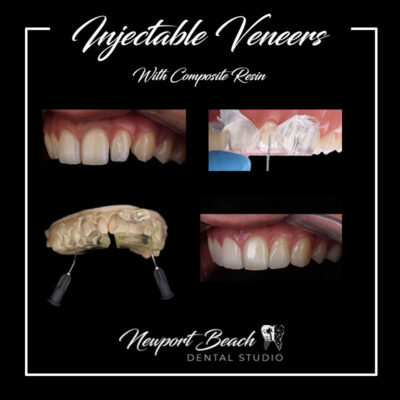
What Are Injectable Veneers?
Injectable veneers are a form of direct composite veneer treatment.
Instead of manually sculpting the entire new tooth shape freehand, Dr. Ha first plans the desired smile digitally.
A model of the planned teeth is created, and a clear silicone matrix is made from that design. The matrix fits over the patient’s teeth and contains the exact shapes that were planned digitally.
An injectable composite resin is then placed through small openings in the matrix. The resin fills the planned tooth form, is light-cured, and bonds to the prepared enamel.
Once the matrix is removed, the restorations are carefully finished, adjusted, and polished.
Why Digitally Design Composite Veneers First?
Composite is a direct restorative material, but that does not mean the final tooth shape should be improvised at the treatment appointment.
Digital planning allows Dr. Ha to evaluate tooth length, width, proportions, symmetry, smile arc, tooth display, spacing, and the relationship between the teeth and lips before treatment begins.
The injection matrix then helps transfer that planned design into the mouth with greater consistency than attempting to build every tooth completely freehand.
What Can Injectable Veneers Improve?
Injectable Veneers Are Not the Same as Simply Covering Crooked Teeth
Adding composite increases the external volume of a tooth.
If a tooth is already significantly rotated, crowded, or positioned too far toward the lips, simply adding material can create a bulky or unnatural result.
In these cases, clear aligners, limited tooth preparation, porcelain veneers, or another treatment may produce a better outcome.
Do Injectable Veneers Require Drilling?
Many injectable veneer cases are primarily additive, which means composite is bonded to existing enamel rather than creating space by aggressively reducing the teeth.
In selected cases, little or no facial tooth preparation may be necessary.
However, completely “no-prep” treatment should not be promised for every patient. Minor enamel contouring may sometimes improve the fit, margin position, tooth proportions, or final emergence profile.
The goal is to preserve as much healthy enamel as possible while still creating a restoration that looks natural and can be cleaned appropriately.
How Much Do Injectable Veneers Cost?
Injectable composite veneers are currently offered at a flat fee of $650 per treated tooth.
A $500 non-refundable diagnostic design fee is required before treatment.
The design fee covers digital smile planning, diagnostic design, model fabrication, and the opportunity to review the proposed tooth shapes before the clinical procedure.
Why Is There a Diagnostic Design Fee?
The diagnostic phase is a critical part of injectable veneer treatment.
Before the composite is bonded, the future tooth shapes need to be designed. Digital records are used to plan the smile and create the model from which the injection matrix is fabricated.
This allows you and Dr. Ha to review the proposed size, shape, and proportions before committing to the final restorations.
This clinical diagnostic design is different from our free online Smile Simulator. The simulator provides an initial visual preview, while the diagnostic design uses the records and models required to plan the actual injectable veneer treatment.
The Injectable Veneer Process
Free Online Smile Preview
Curious What a Different Smile Could Look Like?
Before committing to a diagnostic design or cosmetic consultation, you can upload a photo and use our complimentary Smile Simulator to explore a potential smile makeover from your phone.
You can preview cosmetic smile changes involving veneers or crowns, or compare them with whitening and orthodontic simulations if you are not yet sure which direction interests you.
PREVIEW MY SMILE FREEThe Smile Simulator is a visualization tool only. It does not determine whether injectable veneers or another procedure are clinically appropriate and does not replace diagnostic treatment planning.
How Many Teeth Should Be Treated?
There is no universal number of veneers that every patient needs.
The number depends on how many teeth show during a natural smile and how the planned restorations blend with the untreated neighboring teeth.
Some patients may need only two or four teeth treated. Others may benefit from treating six, eight, ten, or another number across the visible smile.
The goal is not to treat a predetermined number of teeth. It is to create a natural transition between treated and untreated teeth while achieving the desired smile proportions.
Why We Usually Do Not Veneer Molars
Injectable veneers are primarily an esthetic treatment for teeth visible in the smile.
Molars experience heavier chewing forces and generally do not contribute significantly to the visible smile. When a molar requires restorative treatment, a filling, onlay, crown, or another restoration is usually more appropriate.
Who Is a Good Candidate?
Who May Need Another Treatment Instead?
Severe crowding, large rotations, major bite problems, extensive decay, significantly weakened teeth, large existing restorations, active gum disease, or severe structural damage may make injectable veneers inappropriate.
Some patients will achieve a healthier or more natural result with orthodontics, whitening, traditional bonding, porcelain veneers, crowns, or another restorative treatment.
Injectable Veneers vs. Porcelain Veneers
Injectable Composite Veneers
Composite is bonded directly to the teeth using the digitally planned matrix.
Treatment can often be highly conservative, is generally less expensive than porcelain, and composite can usually be repaired or modified directly in the mouth.
Porcelain Veneers
Porcelain veneers are laboratory-fabricated ceramic restorations that generally provide greater long-term color stability and different optical characteristics.
Depending on the case, they may require more tooth preparation and generally involve a higher treatment cost.
Learn more about our porcelain veneer options .
Injectable Veneers vs. 3D-Printed Veneers
Injectable Veneers
The restoration is formed directly on the tooth using composite resin and a clear injection matrix.
This can make treatment conservative and relatively easy to repair or modify.
3D-Printed Veneers
The veneer itself is digitally designed and manufactured outside the mouth before being bonded to the tooth.
This creates a separate indirect restoration and offers different material and finishing characteristics.
Learn more about our 3D-printed veneer technology .
Composite Is Repairable—But It Also Requires Maintenance
One advantage of composite is that small chips, surface wear, or contour changes can often be repaired directly without replacing the entire restoration.
However, composite is not identical to porcelain. Over time it can lose some surface polish, stain, wear, or chip.
Periodic polishing or repair may therefore be part of maintaining injectable veneers over the years.
How Long Do Injectable Veneers Last?
There is no guaranteed lifespan for composite veneers.
Well-planned and well-maintained composite restorations can function for several years, but longevity depends on the amount of composite, bite forces, tooth structure, bonding conditions, grinding or clenching, diet, oral hygiene, and maintenance.
The benefit of composite is that wear or small fractures can often be repaired or refinished rather than requiring complete replacement immediately.
Do Injectable Veneers Stain?
Composite resin can change color or lose surface polish over time more readily than many ceramic materials.
Coffee, tea, tobacco, highly pigmented foods, surface wear, and oral habits can affect appearance.
Professional polishing can sometimes refresh the surface. More significant discoloration or wear may require repair or replacement of selected areas.
Can Injectable Veneers Be Removed?
Composite veneers are bonded to the teeth.
If treatment was completely additive, removal may be possible while preserving much of the underlying enamel. However, removing bonded composite requires careful clinical instrumentation, and the process should not be considered perfectly reversible.
If any enamel was intentionally reshaped before treatment, that change remains even if the composite is later removed.
Do Injectable Veneers Look Natural?
The result depends heavily on design, material selection, surface anatomy, polish, shade, tooth proportions, and the clinician’s finishing technique.
Dr. Ha plans the teeth as part of the entire smile rather than treating each tooth as an isolated white rectangle.
Small variations in facial contour, incisal shape, line angles, tooth length, and symmetry can make the difference between a natural result and an obviously restored smile.
Frequently Asked Questions About Injectable Veneers
Can I preview my smile before deciding on injectable veneers?
Yes. Our free Smile Simulator lets you upload a photo and create an initial cosmetic smile makeover visualization. It can also generate orthodontic and teeth-whitening simulations. This is separate from the detailed diagnostic smile design used to plan actual injectable veneer treatment.
What are injectable veneers made from?
They are made from tooth-colored composite resin that is injected into a clear matrix based on the planned smile design and then bonded directly to the teeth.
Are injectable veneers the same as porcelain veneers?
No. Injectable veneers are direct composite restorations, while porcelain veneers are indirect ceramic restorations fabricated outside the mouth.
Do injectable veneers require shaving my teeth?
Many cases can be treated with little or no facial enamel reduction. However, limited contouring may occasionally improve the final result.
How much do injectable veneers cost?
Newport Beach Dental Studio currently charges $650 per treated tooth plus a $500 non-refundable diagnostic design fee.
What does the $500 design fee cover?
The fee covers the diagnostic design process used to digitally plan the proposed smile, fabricate the models, and prepare for the injection-molding procedure. This is a clinical treatment-planning process and is separate from the complimentary online Smile Simulator.
How many injectable veneers do I need?
There is no standard number. Treatment should be based on the teeth visible in your smile, the cosmetic changes needed, and how the restored teeth will blend with untreated teeth.
Do injectable veneers stain?
Composite can stain or lose polish over time. Professional maintenance and polishing can help preserve the appearance.
Can injectable veneers chip?
Yes. Like other composite restorations, they can chip or wear, particularly in patients with heavy bite forces or grinding. One advantage is that composite is often repairable.
How long do injectable veneers last?
There is no guaranteed lifespan. Longevity varies according to bite, bonding, tooth structure, habits, maintenance, and the amount and location of composite.
Can I whiten injectable veneers later?
Whitening products lighten natural tooth structure but do not predictably change the shade of existing composite. If you are considering whitening, it is often better to address tooth color before selecting the final veneer shade.
Can injectable veneers fix crooked teeth?
Minor visual irregularities may sometimes be improved, but significantly rotated or crowded teeth are often better treated with orthodontics rather than adding excessive restorative material.
Considering Injectable Veneers in Newport Beach?
If you want to improve tooth shape, proportions, spacing, or symmetry while preserving as much natural enamel as possible, schedule a cosmetic consultation with Dr. Tai Ha at Newport Beach Dental Studio.
Not ready for a consultation yet? Start with our complimentary Smile Simulator to preview possible cosmetic smile changes from home, then decide what you would like to explore further.
Injectable veneer candidacy, tooth preparation, design, number of teeth, longevity, maintenance, and final results depend on the patient’s enamel, bite, tooth position, periodontal health, restorative condition, habits, and individual treatment plan.