
Cosmetic Dentistry Case Study · Newport Beach
10 Black Triangle Spaces Treated · Bioclear Matrix System · Additive Composite Restorations · No Enamel Removal
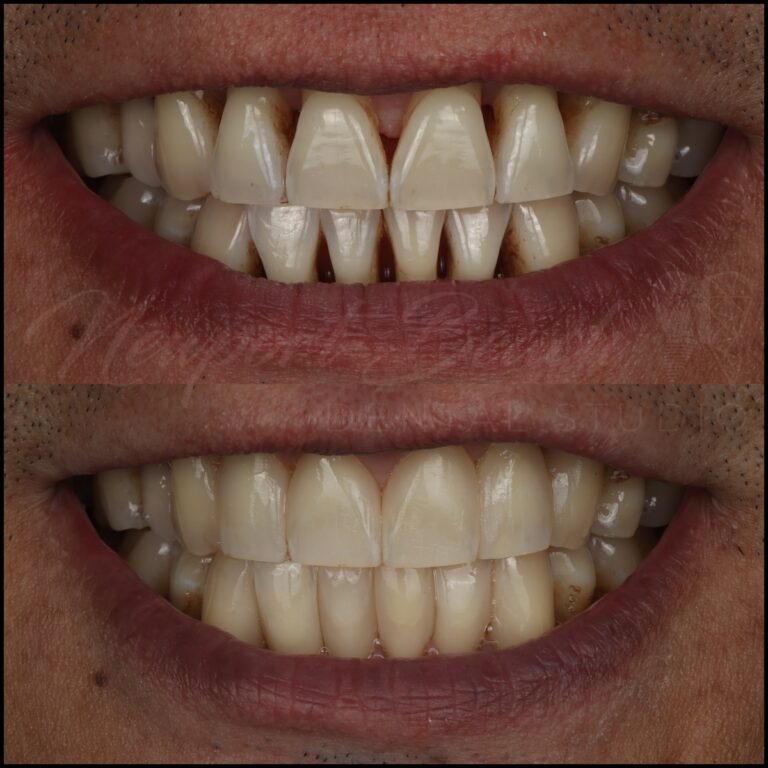
The Patient’s Concern
This patient came to Newport Beach Dental Studio concerned about multiple dark spaces between his front teeth. Often referred to as black triangles, these open spaces were particularly noticeable when he smiled and had become a significant cosmetic concern for him.
In this case, the black triangles were associated with loss of supporting bone and the corresponding loss of gingival tissue between the teeth. As the tissue receded, the spaces beneath the natural contact areas of the teeth became increasingly visible.
Rather than preparing otherwise intact teeth for porcelain veneers or crowns, we evaluated a completely additive approach designed to preserve his existing enamel while improving the contours between the teeth.
What We Changed
BEFORE
- Multiple visible black triangles
- Loss of interdental gum tissue
- Dark spaces throughout the anterior smile
- Interrupted visual continuity between teeth
- Patient was self-conscious about his smile
AFTER
- Five upper spaces treated
- Five lower spaces treated
- Black triangles significantly reduced
- Improved interproximal tooth contours
- More continuous appearance across the smile
- No enamel intentionally removed
A Closer Look at the Transformation
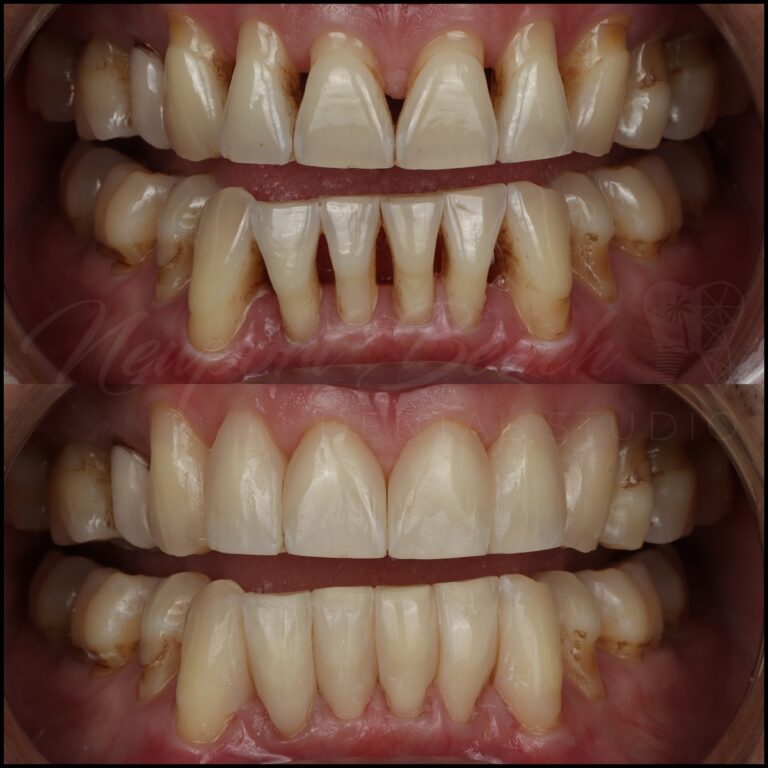
Analyzing the Transformation
The retracted photographs demonstrate the extent of the open gingival embrasures more clearly. Five spaces in the upper arch and five spaces in the lower arch were treated.
The objective was not simply to place composite into the spaces. The interproximal contours of the teeth needed to be redesigned so the restorations could extend the contact areas toward the gingiva and reduce the visible black triangles while maintaining appropriate contours around the surrounding tissues.
This is where the matrix system becomes especially important. By controlling the shape of the composite as the restoration is created, we can change the emergence and interproximal form of the teeth rather than simply placing conventional freehand bonding into an open space.
What Is the Bioclear Matrix System?
Bioclear is not a type of composite material. It is a specialized matrix system and restorative technique used to help control the shape of composite restorations.
For a black triangle case like this, specially shaped matrices are positioned between the teeth. The matrices help establish the form and contour of the restoration as composite is placed, allowing us to rebuild the interproximal surfaces of the teeth and extend the contact areas into the spaces where gingival tissue has been lost.
The result is a controlled way to reshape the teeth with composite while preserving the underlying natural tooth structure.
The Restorative Material
The restorative material used in this case was a universal-shade nanofilled composite. The composite and the Bioclear Matrix System serve two different purposes: the composite is the restorative material, while the Bioclear matrices help control the shape and contour of that material as the restorations are created.
The composite was selected for its ability to blend with the patient’s existing tooth structure and achieve a smooth, highly polished surface. This was especially important because the goal was to make the newly restored areas visually integrate with the patient’s natural teeth rather than appear as separate additions.
A Completely Additive Approach
One of the most important aspects of this particular case was what we didn’t do. The teeth did not need to be shaved down for veneers or crowns, and no enamel was intentionally removed as part of the cosmetic correction.
Instead, restorative material was added to the existing tooth surfaces to change the interproximal contours and close the unwanted spaces. Preserving natural tooth structure whenever clinically appropriate is an important part of our approach to conservative cosmetic dentistry.
The Treatment Timeline
Appointment 1 — Consultation
We evaluated the patient’s smile, periodontal condition, black triangles and existing tooth contours. After discussing his goals and treatment options, we determined that an additive composite approach using the Bioclear Matrix System was appropriate for this case.
Appointment 2 — Treatment
A dedicated treatment appointment of approximately three to four hours was reserved. Five upper spaces and five lower spaces were restored during the same visit using composite shaped with the Bioclear Matrix System.
Follow-Up
The patient returned for a follow-up evaluation and radiographs. The interproximal restorations were carefully checked, and minor adjustments were completed as needed to help ensure there was no excess composite or overhanging material that could contribute to gingival irritation.
Treatment Details
| Primary Concern | Multiple anterior black triangles |
| Underlying Cause | Loss of supporting bone and interdental gingival tissue |
| Treatment | Additive composite restorations for black triangle closure |
| Matrix System | Bioclear Matrix System |
| Restorative Material | Universal-shade nanofilled composite |
| Spaces Treated | 5 upper + 5 lower |
| Tooth Preparation | No intentional enamel removal |
| Active Treatment Time | Approximately 3–4 hours |
| Approximate Fee for This Case | Approximately $500 per space; 10 spaces were treated for an approximate total treatment fee of $5,000 |
| Active Treatment Visits | One treatment visit following consultation |
| Follow-Up | Clinical evaluation, radiographs and minor adjustments as needed |
What Did This Treatment Cost?
For this particular case, the fee was approximately $500 per space. Because five upper spaces and five lower spaces were treated, the patient’s total treatment fee was approximately $5,000.
Fees can vary depending on the number of spaces being treated, the size and location of the black triangles, the amount of contour modification required and the complexity of the individual case. A clinical examination is necessary to determine whether this type of additive treatment is appropriate and to provide an individualized treatment plan and fee.
Maintaining the Result
Like all composite restorations, these restorations require appropriate home care, professional cleanings and periodic evaluation. Longevity can vary depending on oral hygiene, bite forces, habits, periodontal stability and other individual factors.
The location of these restorations is favorable in that much of the added composite is positioned interproximally between the teeth rather than functioning as unsupported material directly along the biting edges. With appropriate care, these restorations can provide many years of service, although no specific lifespan can be guaranteed.
Continued periodontal maintenance is particularly important because the original black triangles were associated with loss of supporting bone and gingival tissue. Closing the visible spaces improves their appearance but does not replace the need to monitor the underlying periodontal condition.
The Final Result
The completed treatment significantly reduced the dark spaces throughout the patient’s smile while preserving his natural tooth structure. The change is particularly evident in the retracted before-and-after photographs, where the new interproximal contours can be evaluated directly.
Because the treatment was additive, we were able to create a more continuous appearance across both the upper and lower anterior teeth without preparing the teeth for porcelain restorations.
Most importantly, we addressed the cosmetic concern that originally brought the patient to our office. He was extremely satisfied with the improvement and felt significantly more confident about his smile.
Concerned About Black Triangles Between Your Teeth?
Not every black triangle requires veneers or crowns. Depending on your teeth, gums and underlying periodontal condition, additive composite treatment may provide a conservative option for improving these spaces while preserving natural tooth structure.