
Cosmetic Dentistry Case Study • Newport Beach
2 No-Prep Feldspathic Veneers • Teeth #7 & #10 • KöR Whitening • Additive Dentistry • Retainer Protection
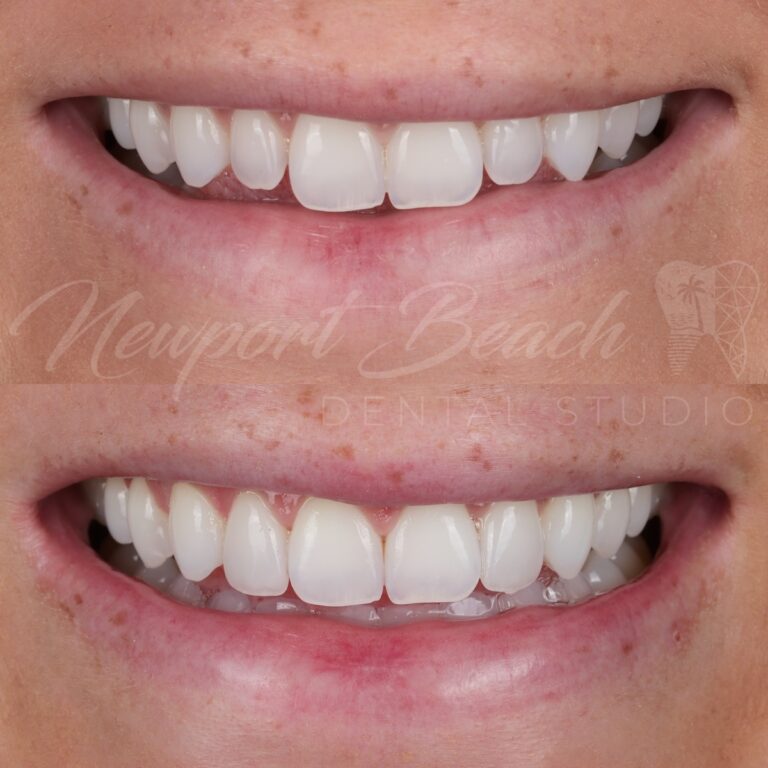
Two ultra-conservative feldspathic porcelain veneers were added to the upper lateral incisors to improve tooth proportions and create a more balanced relationship with the central incisors.
The Patient’s Concern
This patient came to Newport Beach Dental Studio because she felt that her two upper central incisors visually dominated her smile while the adjacent lateral incisors appeared too small.
The central incisors themselves were not necessarily the problem. Much of the imbalance came from the relative size difference between the central and lateral incisors. The treatment goal was therefore to improve the overall proportions of the anterior smile without unnecessarily treating otherwise healthy teeth.
Rather than placing veneers across the entire smile, we focused only on teeth #7 and #10, the two upper lateral incisors.
What We Changed
BEFORE
- Central incisors visually dominated the smile
- Upper lateral incisors appeared comparatively small
- Less harmonious anterior tooth proportions
- Reduced visual continuity across the front teeth
- Patient wanted a brighter overall tooth color
AFTER
- 2 no-prep feldspathic porcelain veneers
- Treatment limited to teeth #7 and #10
- Increased apparent lateral-incisor size
- Improved central-to-lateral tooth proportions
- More continuous anterior smile
- Natural surrounding teeth preserved
- Improved overall color following KöR Whitening
Why Only Two Veneers?
One of the most important decisions in cosmetic dentistry is determining how much dentistry is actually necessary. In this case, the patient’s concern could be addressed by changing the apparent dimensions of only the two lateral incisors.
Increasing the facial volume and visible dimensions of #7 and #10 changed their relationship with the larger central incisors. This allowed the existing central teeth to appear less dominant without placing restorations on them.
The result is an example of additive cosmetic dentistry: adding carefully designed restorative volume where it is needed rather than treating additional teeth simply to create a larger smile makeover.
The Challenge: Matching Only Two Teeth
Restoring only two teeth can be more demanding than treating an entire smile because the new ceramics must integrate directly with untouched natural teeth on both sides.
Color alone is not enough. The ceramic must reproduce the surrounding teeth’s value, translucency, surface texture, light reflection and internal character while also improving the desired tooth proportions.
For this case, the two definitive veneers integrated successfully with the surrounding natural dentition on the first definitive delivery.
A Closer Look at the Color Match
The oblique views show how the two feldspathic veneers blend with the untreated central incisors, canines and surrounding natural teeth from multiple angles.
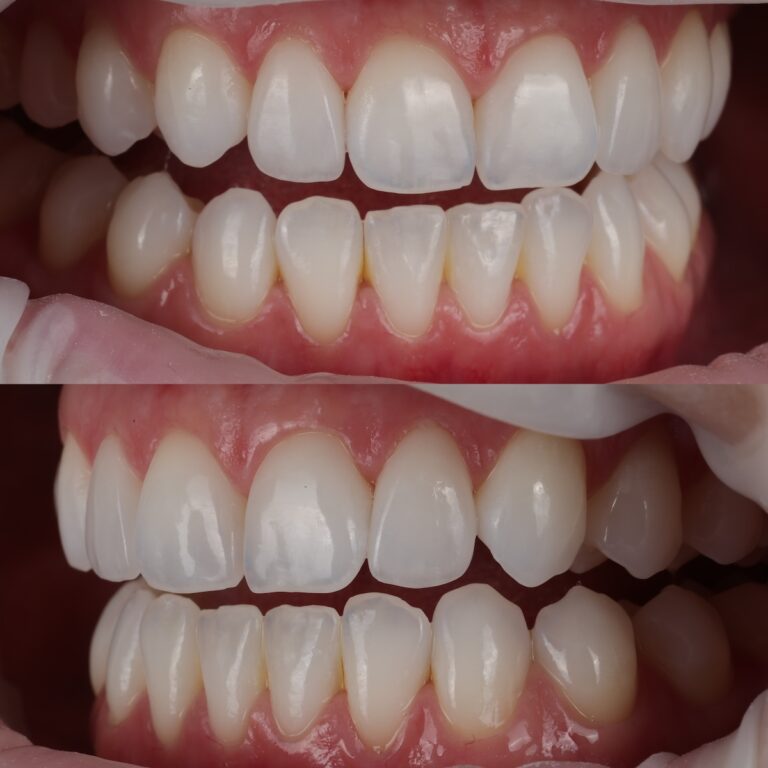
Oblique clinical views demonstrate the integration of the no-prep feldspathic veneers on #7 and #10 with the surrounding natural dentition.
Why Feldspathic Porcelain?
Feldspathic porcelain was selected because extremely thin ceramic restorations can be fabricated while maintaining excellent optical properties. This was particularly useful in a case where the restorations needed to blend directly into untreated natural teeth.
The thin ceramic allows the underlying tooth structure to contribute to the final appearance of the veneer rather than completely masking it. The result depends on the interaction between the natural tooth substrate, the bonding materials and the feldspathic ceramic.
This makes feldspathic porcelain especially useful in carefully selected conservative cases where preserving natural enamel and achieving a highly integrated color match are priorities.
No-Prep Veneers on #7 & #10
Because the lateral incisors needed additional volume rather than reduction, this case was appropriate for a no-prep additive approach.
The veneers were designed to increase the apparent size and contour of teeth #7 and #10 while preserving the underlying tooth structure.
Not every patient is a candidate for no-prep veneers. Tooth position, existing volume, bite, desired color change and the amount of restorative space available must all be evaluated before choosing an additive approach.
Whitening Before the Veneers
The patient completed KöR Whitening before the definitive ceramic color was selected. Whitening the surrounding natural teeth first allowed us to establish the brighter overall tooth color she wanted before asking the laboratory technician to match the two veneers.
She whitened at home for approximately two weeks. After whitening, we allowed the tooth color time to stabilize before obtaining updated photographs and color records for the laboratory technician.
This sequencing is especially important when only a small number of veneers are being placed because the restorations must be matched to the surrounding natural teeth after whitening rather than before it.
Analyzing the Smile Design
Central-to-Lateral Proportions
In the pretreatment smile, the central incisors appeared especially dominant because the lateral incisors were comparatively narrow and small. Increasing the apparent dimensions of the laterals created a more graduated transition from the central incisors toward the canines.
Smile Continuity
The final smile demonstrates greater continuity across the anterior teeth. The laterals now occupy more appropriate visual space between the central incisors and canines, helping the smile appear more cohesive without changing the remaining natural teeth.
Preserving Natural Tooth Character
Because the majority of the patient’s smile remained natural, the restorations needed to disappear into the surrounding dentition rather than establish an entirely new ceramic appearance. The translucency of the thin feldspathic restorations allowed the natural underlying tooth color to contribute to the final optical result.
Color Match From Multiple Angles
The additional side views are particularly useful in this case because they show the veneers from oblique angles rather than only from the front. This makes differences in value, translucency, facial contour and light reflection easier to evaluate. The goal was for #7 and #10 to integrate with the adjacent natural teeth rather than appear as two isolated restorations.
A Conservative Smile Makeover
This case demonstrates that a smile makeover does not necessarily require treating eight, 10 or 20 teeth. When the diagnosis is appropriate, changing only two carefully selected teeth can alter the visual proportions of the entire anterior smile.
Treatment Sequence
01 — Consultation, Scans & Photography
The initial appointment included evaluation of the patient’s tooth proportions and cosmetic goals along with digital scans and clinical photography.
02 — KöR Whitening
The patient returned to receive her KöR Whitening trays and completed approximately two weeks of whitening at home.
03 — Color Stabilization & Updated Records
After allowing the whitened teeth time to stabilize, updated photographs and color information were obtained for the laboratory technician. These records were used to reproduce the optical characteristics of the surrounding natural teeth as closely as possible.
04 — Final Veneer Delivery
The two no-prep feldspathic veneers were evaluated and delivered in approximately 90 minutes. Final cleanup, evaluation and clinical photographs were completed at the same visit.
Treatment Details
| Treatment | No-prep feldspathic porcelain veneers |
| Number of Veneers | 2 |
| Teeth Treated | #7 and #10 — upper lateral incisors |
| Preparation | No-prep / additive approach |
| Ceramic | Layered feldspathic porcelain |
| Whitening | KöR Whitening before final shade matching |
| Primary Concern | Dominant central incisors and comparatively small lateral incisors |
| Treatment Goal | Increase lateral-incisor dimensions and improve anterior tooth proportions while preserving untreated natural teeth |
| Whitening Duration | Approximately 2 weeks at home |
| Delivery Appointment | Approximately 90 minutes |
| Protection | Retainer provided after treatment |
Protecting the Result
After delivery, the patient was provided with a retainer to help maintain tooth position and provide additional protection for the completed restorations during sleep.
Routine examinations, professional cleanings and appropriate home care remain important for maintaining both the porcelain restorations and the surrounding natural teeth.
The Final Result
The finished smile demonstrates a more balanced relationship between the central and lateral incisors while preserving the patient’s remaining natural anterior teeth.
By selectively adding volume to only #7 and #10, the central incisors appear less dominant and the progression across the anterior smile is more uniform.
The feldspathic ceramic blends with the surrounding whitened natural dentition while maintaining the conservative, no-prep approach that made this case possible.
Considering No-Prep Veneers?
In carefully selected cases, no-prep veneers can improve tooth proportions using an additive approach that preserves natural tooth structure. The key is determining whether your existing tooth position, bite, color and available restorative space make conservative treatment possible.