
Cosmetic Dentistry Case Study • Newport Beach
Veneer Replacement • Layered E.max • BL2 MT • Natural Incisal Translucency • Digital Smile Design
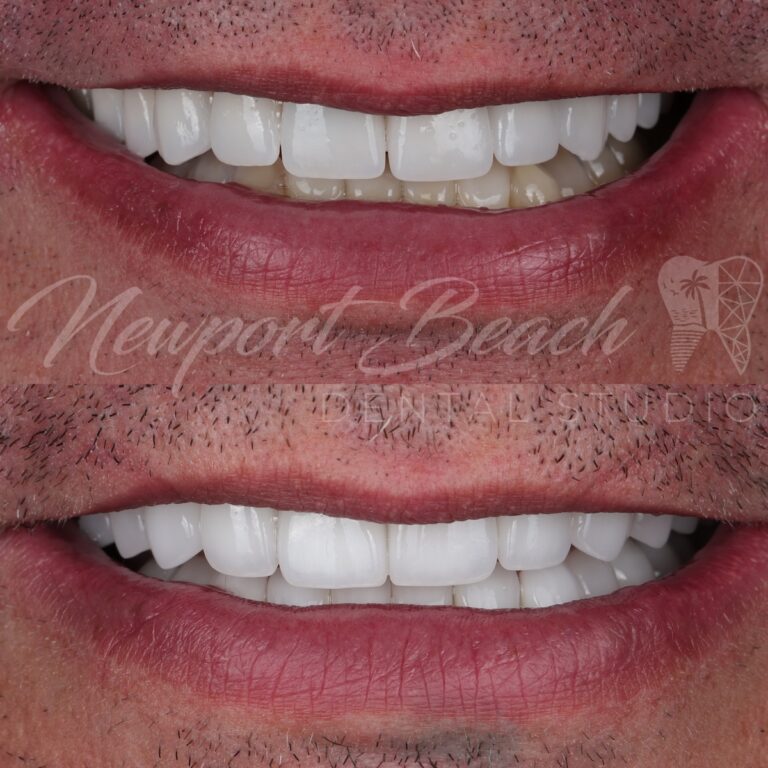
Older monolithic E.max veneers were replaced with individually layered BL2 MT E.max restorations to improve tooth display, proportions, smile curvature, embrasures, translucency and overall harmony.
The Patient’s Concerns
This patient came to Newport Beach Dental Studio after living with his previous veneers for more than 10 years. Although the existing restorations were bright, he had never been completely satisfied with the overall design of his smile.
His goal was not simply to make the teeth whiter. He wanted a smile that displayed more tooth when he smiled, flowed more naturally with his lips and face, and had greater depth and realism than his older monolithic restorations.
The existing smile also demonstrated a less favorable incisal progression, including a reverse smile-curve tendency. Differences in tooth angulation, proportions, spacing and embrasure form further affected how smoothly the teeth transitioned across the smile.
The challenge was therefore to keep the smile recognizable while improving the architecture that determines whether a veneer case looks merely white or genuinely harmonious.
What We Changed
BEFORE
- Older monolithic E.max veneers
- Bright color but limited optical depth
- Reverse smile-curve tendency
- Reduced tooth display
- Less favorable anterior tooth proportions
- Variations in tooth angulation
- Irregular spacing relationships
- Less refined embrasure progression
- Smile appeared flatter and less dimensional
AFTER
- Layered E.max porcelain veneers
- Final shade BL2 MT
- Medium surface texture
- Natural incisal translucency
- Increased visible tooth length
- Improved smile curve
- Refined tooth angulation
- Improved width-to-length proportions
- More natural embrasure progression
- Greater depth, texture and ceramic characterization
White Veneers vs. a Designed Smile
One of the clearest lessons from this case is that veneer esthetics depend on much more than shade. The patient’s previous restorations were already white, yet he remained dissatisfied with the smile for more than a decade.
The perception of a smile is influenced by tooth length, width-to-length relationships, axial inclination, incisal-edge position, facial contours, line angles, embrasures, surface texture, translucency and how the teeth relate to the lips and surrounding face.
Improving those relationships created a much larger visual change than simply selecting a brighter ceramic shade.
Monolithic vs. Layered E.max
The previous veneers were monolithic E.max restorations. Monolithic ceramic can be an appropriate restorative option, but this patient wanted greater control over the optical characteristics of the final smile.
For the replacement smile, layered E.max in shade BL2 MT was selected and individually characterized with porcelain.
Medium surface texture and natural incisal translucencies were incorporated to create variation in light reflection, depth and internal character rather than a uniformly white ceramic appearance.
A Closer Look at the Transformation
The 50/50 comparison demonstrates how changes in tooth length, angulation, embrasure design and ceramic characterization alter the appearance of the entire smile even when both sets of veneers are relatively bright.
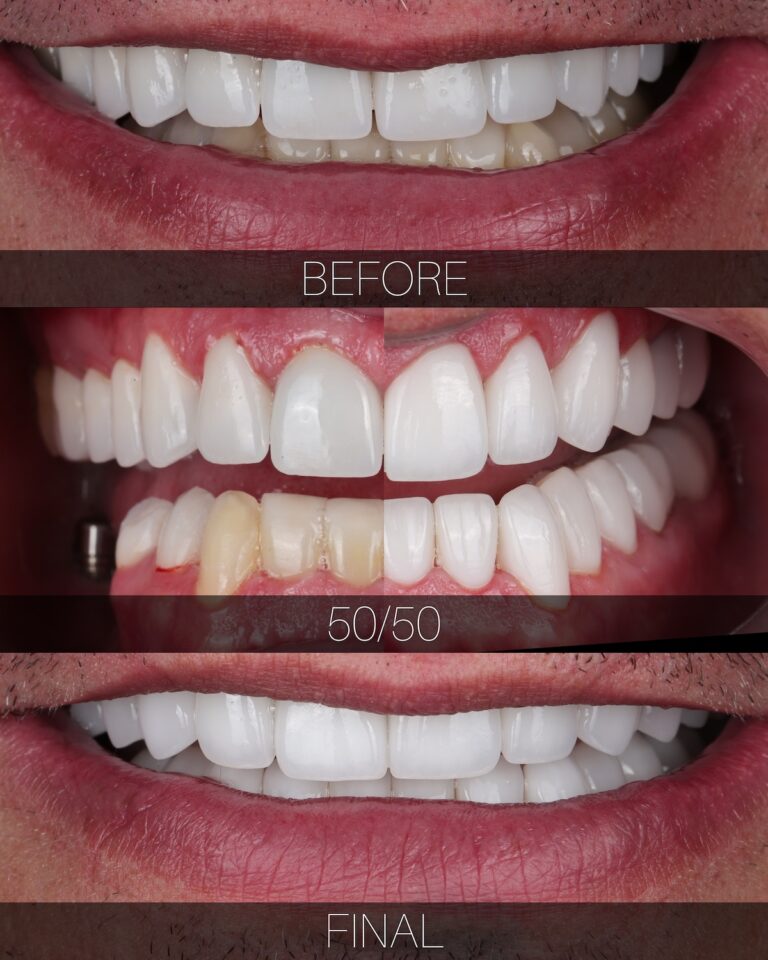
The 50/50 view highlights the difference in tooth proportions, incisal-edge position, embrasure form, surface texture and translucency between the old and new veneers.
Analyzing the Smile Design
Correcting the Reverse Smile Curve
The pretreatment incisal edges created a less favorable relationship with the curvature of the lower lip. The replacement design altered the incisal-edge positions to create a smoother, more harmonious progression across the anterior smile.
Increasing Tooth Display
The patient wanted more of his teeth to show when smiling. A controlled increase in visible tooth length created greater anterior presence without making the final restorations appear excessively large.
Improving Tooth Proportions
Length was coordinated with apparent tooth width so the final restorations maintained more favorable width-to-length relationships. The central incisors retain appropriate visual dominance while the lateral incisors and canines transition more gradually through the smile.
Correcting Tooth Angulation
Subtle differences in axial inclination can substantially alter the way light reflects from the facial surfaces of the teeth. The new veneer contours were designed to create a more consistent orientation and smoother visual flow across the anterior teeth.
Redesigning the Embrasures
The spaces created between the incisal corners of adjacent teeth — known as incisal embrasures — influence whether a smile looks natural or overly uniform.
The replacement veneers were designed with a more deliberate embrasure progression, beginning more subtly between the central incisors and gradually increasing toward the lateral incisors and canines. This creates clearer tooth separation and a more natural rhythm across the smile.
Transitional Line Angles & Facial Reflections
The position of the facial line angles influences how wide or narrow a tooth appears even when its actual dimensions remain similar. Refining these reflective surfaces allowed the apparent proportions of the teeth to be controlled while preserving individualized anatomy.
Medium Surface Texture
The final restorations incorporate a medium degree of surface texture. These subtle surface variations break up reflected light and prevent the teeth from appearing excessively flat or polished.
Natural Incisal Translucency
The incisal portions of natural teeth typically interact with light differently than the cervical portions. The layered E.max veneers were characterized with natural incisal translucency to recreate this variation and add depth to the final ceramics.
Curve of Spee, Curve of Wilson & Smile Architecture
A cosmetic smile design cannot be evaluated only from a straight frontal photograph. The position of the teeth must also be considered within the three-dimensional architecture of the dental arches and occlusion.
During planning, the restorative design was coordinated with the patient’s existing Curve of Spee and Curve of Wilson so changes in tooth length, contour and visible width remained compatible with the broader occlusal relationships.
This three-dimensional approach helped create a smile that appears more balanced from both frontal and oblique perspectives rather than designing the veneers solely for a single photograph.
Digital Smile Design Before Treatment
Digital smile design protocols guided the planning of this case before the definitive restorations were fabricated.
Clinical photographs, digital records and the existing smile were evaluated to determine the desired tooth lengths, apparent widths, angulations, incisal-edge positions and embrasure progression.
Planning digitally allowed the new smile architecture to be evaluated before committing to the final ceramic restorations and provided a clear communication reference for the restorative and laboratory teams.
It Is Not About Making Every Tooth Perfect
Natural smiles contain variation. Central incisors, lateral incisors and canines should not simply be copies of one another at different widths.
The objective in this case was to create hierarchy, progression and harmony: dominant central incisors, appropriately subordinate lateral incisors, defined canines, progressive embrasures and ceramic characterization that responds naturally to light.
The goal was not mathematical perfection. It was to make the entire smile make visual sense.
Treatment Details
| Treatment | Replacement porcelain veneers |
| Previous Restorations | Monolithic E.max veneers more than 10 years old |
| New Ceramic | Layered E.max |
| Final Shade | BL2 MT |
| Translucency | Medium translucency with individualized natural incisal effects |
| Surface Character | Medium surface texture with individualized light reflection |
| Primary Concerns | Old veneer design, reduced tooth display, reverse smile curve, proportions, angulation, spacing relationships and limited ceramic dimension |
| Treatment Goals | Brighter appearance, increased tooth display, improved smile curve, refined proportions and angulations, progressive embrasures and more natural ceramic depth |
| Smile Planning | Digital smile design with evaluation of tooth dimensions, incisal position, embrasures and overall smile architecture |
| Occlusal Considerations | Restorative design coordinated with existing Curve of Spee, Curve of Wilson and functional occlusal relationships |
The Final Result
The final smile is brighter and displays more tooth, but the larger transformation comes from the architecture of the restorations rather than color alone.
Correcting the incisal progression improved the smile curve, while changes in tooth length, width-to-length relationships and axial inclination created a more balanced anterior composition.
Progressive embrasures provide more natural separation from tooth to tooth, while medium surface texture and individualized incisal translucency give the layered E.max ceramics significantly more visual depth.
The result is not simply a new set of veneers. It is a smile in which the proportions, contours, ceramic optics and relationship to the lips work together as one design.
Considering Replacing Older Veneers?
If your veneers are already white but something about the smile still feels wrong, the issue may involve much more than shade. Tooth proportions, length, angulation, embrasures, smile curvature, surface texture and ceramic translucency can all influence whether restorations look integrated with your face or simply look like veneers.