
Cosmetic Dentistry Case Study • Newport Beach
2 Layered E.max Veneers • Zirconia Bridge Replacement • KöR Whitening • Biomimetic Philosophy • 3 Appointments
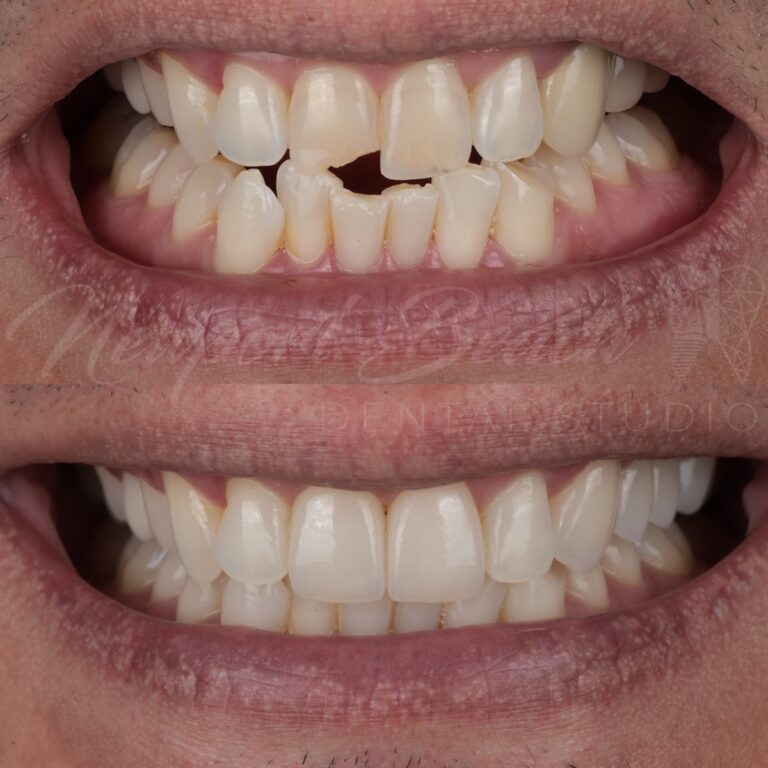
Two layered E.max veneers on the central incisors and replacement of an older upper-left PFM bridge with zirconia created a more cohesive smile without treating every visible tooth.
The Patient’s Concerns
This patient came to Newport Beach Dental Studio after previously placed composite bonding on his two upper central incisors fractured when he bit down on something hard.
During the consultation, we reviewed several treatment options, including replacing the composite bonding or transitioning teeth #8 and #9 to porcelain veneers.
He also expressed concern about an older porcelain-fused-to-metal bridge on the upper-left side. The bridge appeared more opaque than the surrounding natural teeth and did not reproduce the translucency and light behavior visible in the adjacent dentition.
The central incisors were also noticeably warmer in color than he wanted. His goal was a brighter and more cohesive smile, but he did not need or want a full-mouth veneer case.
What We Changed
BEFORE
- Fractured composite bonding on #8 and #9
- Central incisors warmer in color than desired
- Older upper-left PFM bridge
- Opaque bridge ceramic compared with surrounding teeth
- Visible mismatch in color and translucency
- Patient wanted a brighter but conservative result
AFTER
- 2 layered E.max porcelain veneers on #8 and #9
- Upper-left PFM bridge replaced with zirconia
- KöR Whitening of the surrounding natural teeth
- Approximately BL4 overall final value
- Improved translucency and color integration
- More cohesive anterior smile
- Minimal number of teeth treated
Composite Bonding or Porcelain Veneers?
Replacing the fractured composite bonding was a reasonable option and was discussed with the patient. Composite can be an excellent conservative restorative material when appropriately indicated.
For this particular case, however, the patient elected layered E.max porcelain veneers on #8 and #9 after reviewing the esthetic, functional and long-term differences between the two approaches.
Porcelain allowed greater control over surface texture, light reflection, translucency and long-term polish while providing a durable ceramic replacement for the lost facial enamel.
A Biomimetic Restorative Philosophy
The restorative plan was approached with a biomimetic philosophy: preserve healthy tooth structure whenever possible and replace lost tooth tissues with materials whose mechanical behavior is appropriate for the structure being replaced.
When facial enamel has been lost or compromised, bonded ceramic can provide a durable enamel-like outer restorative layer. If internal dentin replacement or build-up is required, materials with more dentin-like mechanical properties can be selected beneath the ceramic.
The objective is not simply to make the tooth look better, but to rebuild it conservatively while respecting the different functional roles of enamel and dentin.
Why Replace the PFM Bridge With Zirconia?
The existing bridge was fabricated from porcelain fused to metal. PFM restorations have a long history in dentistry and can be very durable, but the underlying metal substructure can make the restoration appear more opaque than adjacent natural teeth.
That difference was particularly noticeable in this case because the surrounding natural teeth demonstrated greater translucency and variation in light transmission.
A zirconia bridge was selected for the replacement because zirconia offers high strength while allowing the laboratory technician to create a more refined esthetic result than the previous restoration.
Working closely with a master laboratory technician, the objective was to coordinate the zirconia bridge, two E.max veneers and surrounding natural dentition so the restorations would read as part of the same smile rather than as separate dental work.
Whitening Before Shade Matching
Because the patient wanted a brighter smile, KöR Whitening was completed before the definitive ceramics were fabricated.
He whitened at home for approximately two weeks and then allowed approximately one additional week for the color to stabilize before the final restorative records were obtained.
This allowed the veneers and bridge to be matched to the stabilized post-whitening tooth color rather than to the darker pretreatment shade.
Color Matching Different Materials
One of the more demanding aspects of this case was integrating three different components: natural teeth, layered E.max veneers and a zirconia bridge.
The final shade was approximately BL4, but successful ceramic matching involves much more than selecting a shade tab. Clinical photography and detailed documentation were used to communicate value, translucency, surface texture, characterization and light reflection to the laboratory technician.
The goal was not for every tooth to be identical. The goal was for the ceramics to reproduce enough of the optical characteristics of the surrounding natural dentition that the restorations blended into the smile.
Why This Did Not Require a Full Smile of Veneers
A major part of treatment planning is determining which teeth actually need treatment. In this case, the patient’s concerns could be addressed by restoring the two damaged central incisors, replacing the mismatched bridge and whitening the remaining natural dentition.
There was no clinical or esthetic reason to prepare every tooth visible in the smile simply to create uniformity.
By limiting treatment to the areas that required improvement, we were able to create a substantial esthetic change while preserving as much of the patient’s existing natural dentition as possible.
Completed in Three Appointments
01 — Consultation, Records & Whitening
The fractured composite bonding, existing PFM bridge, tooth color and overall smile were evaluated. Clinical photographs, digital scans and records were obtained, and treatment options were reviewed.
KöR Whitening trays were fabricated and the patient completed approximately two weeks of at-home whitening. The tooth color was then allowed approximately one additional week to stabilize.
02 — Preparation & Temporary Restorations
After digital smile planning and approval of the proposed design, teeth #8 and #9 were prepared for layered E.max veneers and the existing upper-left PFM bridge was removed.
The appointment required approximately three hours. The patient left with temporary veneers on the central incisors and a temporary bridge based on the planned final design.
03 — Final Veneer & Bridge Delivery
At the third appointment, the temporary restorations were removed and the definitive layered E.max veneers and zirconia bridge were evaluated and bonded.
The final delivery appointment required approximately three hours, including evaluation of fit, shade, contacts, bite and integration with the surrounding natural dentition.
Treatment Details
| Treatment | 2 layered E.max veneers and replacement zirconia bridge |
| Veneers | Teeth #8 and #9 |
| Previous Restoration | Older upper-left porcelain-fused-to-metal bridge |
| Replacement Bridge | Zirconia |
| Veneer Ceramic | Layered E.max |
| Approximate Final Shade | Approximately BL4 with individualized characterization |
| Whitening | KöR Whitening before final shade matching |
| Primary Concerns | Fractured composite bonding, darker central incisors and opaque mismatched PFM bridge |
| Treatment Philosophy | Conservative biomimetic approach focused on treating only the teeth and restorations requiring improvement |
| Digital Planning | Clinical photography, digital scans and digital smile design / wax-up |
| Appointments | 3 — consultation and records, preparation and temporization, definitive delivery |
| Preparation Appointment | Approximately 3 hours |
| Delivery Appointment | Approximately 3 hours |
| Protection | Upper and lower retainers provided after treatment |
| Future Treatment | Patient plans to consider aligner therapy for additional tooth alignment |
Protecting the Result
After the definitive restorations were delivered, digital scans were obtained for upper and lower retainers.
The retainers help maintain tooth position and provide additional protection for the ceramic restorations during sleep. This was particularly relevant because the patient is considering aligner treatment in the future to further improve tooth alignment.
Routine examinations, professional cleanings and appropriate home care remain important for maintaining the restorations and surrounding natural teeth.
How Long Can Porcelain Veneers Last?
Well-maintained bonded porcelain veneers can often remain successful for many years. A range of approximately 10 to 20 years is possible in appropriate cases, but restoration longevity varies considerably from patient to patient.
Bite forces, clenching or grinding, oral hygiene, trauma, diet, recurrent decay and routine maintenance can all influence how long an individual restoration remains in service. No specific lifespan can be guaranteed.
The Final Result
The completed smile demonstrates how a relatively small number of carefully selected restorations can create a meaningful cosmetic improvement.
The two central incisors are brighter and more cohesive after replacement of the fractured bonding with layered E.max veneers, while the zirconia bridge blends more naturally with the surrounding dentition than the previous opaque PFM restoration.
By combining KöR Whitening, detailed photographic shade communication, two porcelain veneers and one bridge replacement, the overall smile was improved without committing the patient to a full set of veneers.
Considering Conservative Cosmetic Dentistry?
Cosmetic dentistry does not automatically mean treating every visible tooth. In carefully selected cases, whitening, a small number of porcelain restorations and replacement of outdated dentistry may be enough to significantly improve the overall smile while preserving healthy natural tooth structure.