
Solea Laser Dentistry in Newport Beach
For many patients, the part they dislike most about dental treatment is not the dentistry itself. It is the injection, the sound and vibration of the drill, and spending the next several hours waiting for numbness to wear off.
At Newport Beach Dental Studio, Dr. Tai Ha uses the Solea dental laser for selected hard- and soft-tissue procedures. In many cases, Solea allows us to perform treatment with little or no conventional drilling and without local anesthetic injections.
That can make procedures such as selected cavity preparations, fillings, gum contouring, and soft-tissue treatment feel very different from a traditional dental appointment.
Needle-Free and Drill-Free Dentistry—When the Case Allows It
Solea gives us another way to treat teeth and gums without automatically reaching for a traditional high-speed handpiece or anesthetic injection.
Some patients can have a cavity prepared and restored without being numb at all. Others may still need local anesthesia because of the depth, location, complexity, or sensitivity of the procedure.
We would rather explain that distinction clearly than promise every patient a completely sensation-free procedure. When Solea can reasonably make treatment more comfortable, we use it.
What Is the Solea Dental Laser?
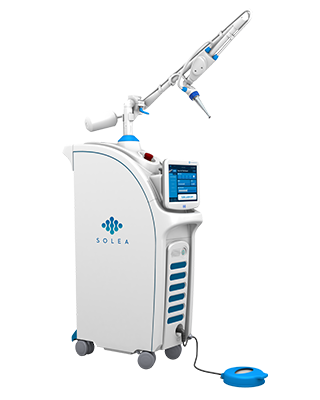
Solea is an advanced CO₂ dental laser designed specifically for dentistry. The system operates at approximately 9.25 microns and delivers pulsed laser energy that can interact with both hard and soft oral tissues.
Unlike many dental lasers that are primarily used for soft tissue, Solea has FDA-cleared indications that include hard-tissue cavity preparation and caries removal, soft-tissue procedures, and selected oral osseous procedures.
This versatility is what makes the technology particularly useful in a comprehensive dental practice. We can use the same system for certain tooth preparations as well as procedures involving the gums and other oral tissues.
How Solea Laser Dentistry Works
How Does Solea Work on Teeth and Gums?
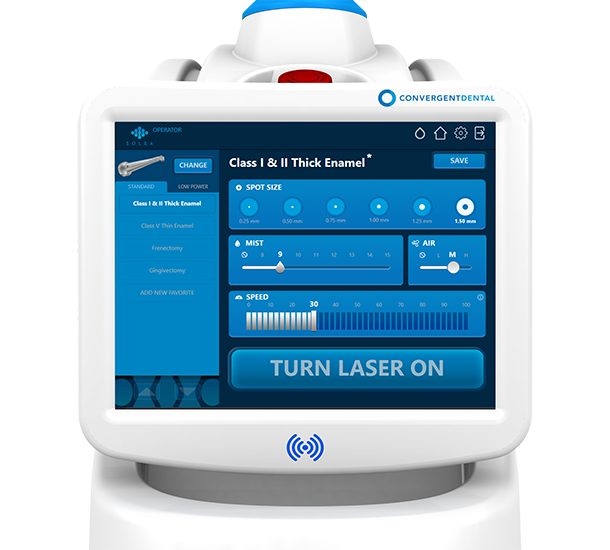
The system delivers highly controlled pulses of CO₂ laser energy to the area being treated. Dr. Ha adjusts the settings according to the tissue and procedure.
On hard dental tissue, the laser can ablate enamel and dentin during selected cavity preparations. On soft tissue, it can cut, contour, vaporize, and coagulate tissue while also providing hemostasis.
One of the distinctive features of Solea is that many patients experience enough of an analgesic effect during appropriate procedures that conventional local anesthetic may not be required.
What a patient feels varies. Some report coolness, pressure, or intermittent sensation. Others feel very little. If additional anesthesia is appropriate, we can always use it rather than forcing a patient to tolerate discomfort simply to say the procedure was “needle-free.”
Can a Cavity Really Be Filled Without a Dental Drill?
For many selected cavities, yes.
Solea is FDA-cleared for hard-tissue ablation used in caries removal and cavity preparation. This allows Dr. Ha to remove affected tooth structure and prepare many restorations with the laser rather than relying entirely on a conventional dental handpiece.
After the preparation is complete, the tooth is restored using the appropriate bonded restorative material just as it would be following another conservative cavity-preparation technique.
Whether Solea can replace the drill completely depends on the size and location of the cavity, existing restorative material, access, depth, and the type of restoration being completed.
What Procedures Can We Perform With Solea?
Dr. Ha may incorporate Solea into a number of restorative and soft-tissue procedures when the laser is clinically appropriate.
Why Patients Like Solea Laser Dentistry
Does Solea Mean I Will Never Need a Shot or Drill?
No. Solea dramatically expands what we can accomplish without conventional drilling or local anesthesia, but it does not eliminate those tools from dentistry.
Deep decay, certain existing restorations, crowns, complex restorative procedures, very sensitive teeth, anatomy, and individual patient response may still make conventional instrumentation or local anesthetic appropriate.
Our objective is not to avoid a needle or handpiece at all costs. It is to choose the technique that allows us to complete the dentistry conservatively, safely, and comfortably.
Solea and Minimally Invasive Dentistry
One reason Solea fits well within our restorative philosophy is control. Dr. Ha favors conservative treatment and preservation of healthy tooth structure whenever possible.
For selected hard-tissue procedures, laser dentistry gives us another method of removing diseased or necessary tooth structure without automatically extending a preparation simply to accommodate a conventional technique.
The same principle applies to soft tissue. The goal is to treat the tissue necessary for the procedure while maintaining control over surrounding areas.
What to Expect During a Solea Appointment
Laser Dentistry for Patients Who Dislike Needles or Drills
Some patients postpone routine dental care because of one very specific fear: the injection. Others are more bothered by the sound, vibration, or sensation of a dental handpiece.
When a procedure can reasonably be completed using Solea without local anesthetic, removing those parts of the appointment can make the experience considerably easier.
This can be particularly useful for anxious patients and for selected younger patients who may have difficulty with injections or lingering numbness. Whether Solea is appropriate still depends on the individual patient and procedure.
Is the Solea Dental Laser FDA Cleared?
Yes. Solea is an FDA-cleared medical device with indications covering dental hard tissue, oral soft tissue, and selected oral bone procedures.
The FDA-cleared indications include hard-tissue ablation for caries removal and cavity preparation; incision, excision, vaporization, coagulation, and hemostasis of oral soft tissue; and cutting, shaving, contouring, and resection of oral osseous tissue.
Solea uses laser light rather than ionizing X-ray radiation. As with other medical lasers, appropriate training, clinical judgment, eye protection, and laser-safety protocols remain important.
The Solea Patient Experience
What About Solea Treatment for Snoring?
We also offer Solea Sleep therapy for selected patients seeking treatment for snoring.
Snoring and obstructive sleep apnea are not the same condition. Because snoring can be a symptom of obstructive sleep apnea, appropriate sleep screening or testing may be recommended before treatment depending on the patient’s history and symptoms.
Frequently Asked Questions About Solea Laser Dentistry
Can Solea really fix a cavity without a drill?
Many selected cavities can be prepared using the Solea laser instead of relying entirely on a conventional dental drill. Whether this is appropriate depends on the size, depth, location, existing restoration, and type of treatment required.
Can I get a filling without a numbing injection?
Many patients can have selected Solea procedures completed without local anesthetic. It is not guaranteed for every patient or every procedure. If anesthesia is needed for comfort or proper treatment, we will use it.
Does the Solea laser hurt?
Patient sensation varies. Some people report little sensation, while others notice coolness, pressure, or brief sensitivity. The clinical situation and individual sensitivity affect the experience.
Is Solea FDA cleared?
Yes. Solea has FDA clearances for dental hard-tissue, soft-tissue, and selected oral osseous applications.
Can Solea be used on gums?
Yes. The laser has soft-tissue indications including incision, excision, vaporization, coagulation, and hemostasis. It may be used for procedures such as selected gum contouring, gingival treatment, and frenectomy when clinically appropriate.
Can Solea be used for children?
Solea may be useful for selected younger patients because some procedures can be performed with less reliance on injections or conventional drilling. Whether it is appropriate depends on the child’s treatment needs, cooperation, anatomy, and clinical situation.
Is laser dentistry better than traditional dentistry?
Not automatically. The laser is another clinical instrument. For some procedures it offers meaningful advantages, while other treatments are better performed using conventional instruments or a combination of techniques.
Will I be numb after my appointment?
If a procedure can be completed without local anesthetic, you will not have the lingering lip or facial numbness normally associated with an injection. If anesthesia is required, normal temporary numbness should be expected.
Can Solea replace the dental drill for every procedure?
No. Conventional handpieces and other dental instruments are still necessary for many treatments. Dr. Ha chooses the technique or combination of techniques that is appropriate for the individual procedure.
Looking for Laser Dentistry in Newport Beach?
If fear of needles, drilling, vibration, or numbness has made you put off dental care, ask us whether your treatment may be appropriate for the Solea dental laser.
Dr. Ha can evaluate the tooth or area being treated and explain whether Solea, conventional treatment, or a combination of techniques makes the most sense for your situation.
SCHEDULE AN APPOINTMENTSolea may reduce or eliminate the need for conventional drilling or local anesthesia in selected procedures. Individual treatment requirements and patient experience vary.